
Alamanuia ma Tupe Teufa'afaigaluega · Industry & investment
Industry & investment
Invest in Samoa, industry development, the Trade Commerce & Manufacturing Sector Plan, and duty-free importation.
We facilitate investment into Samoa and support local industry development. We deliver the Trade, Commerce and Manufacturing (TCM) Sector Plan, process duty-free importation applications, and promote Samoa as an investment destination through partnerships with the Samoa Trade Portal.
Invest in Samoa
Samoa offers foreign and domestic investors a stable, highly favourable and business-friendly environment, backed by a skilled English-speaking workforce, and a strategic location in the Pacific as a gateway to regional and global markets. Our Investment Promotion team is responsible for the promotion, facilitation, registration, and monitoring of foreign investment in Samoa.
Why invest in Samoa?
Investment Opportunities — Samoa welcomes investment in a broad range of sectors subject to the Reserved and Restricted Lists as well as other regulatory requirements. Priority sectors currently include Tourism, Fisheries and Agriculture, ICT, Manufacturing, and Renewable Energy.
Investment enquiries. The Investment Unit handles foreign investment registration, facilitation, and monitoring. Contact the unit directly at investmentinfo@mcil.gov.ws.
Forms & downloads
- Samoa Investment Guide 2026 (PDF)
- Samoa National Investment Policy Statement 2026 (PDF)
- Setting up a Foreign Business in Samoa 2026 (PDF)
- Samoa's Country Value Proposition 2026 (PDF)
- Guide to Private Sector Development Programs 2023 (PDF)
Industry Development
Our Industry Development Unit (IDU) works alongside Samoa's private sector to support business productivity, MSME growth and development across various sectors.
In doing so, the IDU is responsible for the facilitation of various duty exemption schemes; the development, review and implementation of policies for industry and MSME development; monitoring and evaluation; and the development and frequent review of the Guide for Private Sector Development in Samoa.
Duty-free importation
Duty-free importation for qualifying industries has been part of Samoa's industry policy framework since the Industrial Development Act 1984. Today, the operational mechanism is the Duty Concession Scheme, administered under the Customs Amendment Acts 2007 and 2022 and associated regulations — see the schemes section below.
About these scheme summaries. The descriptions below summarise the Ministry's published policy on each scheme. For authoritative Act texts, current section numbers, full eligibility criteria, and the most recent amendments, consult the Samoa Gazette or contact MCIL directly via the sidebar.
Duty Concession Scheme
The Duty Concession Scheme assists eligible businesses in the Manufacturing, Tourism, Agriculture, and Fisheries sectors by allowing the importation of materials on a duty-free basis.
The scheme operates under the Customs Amendment Act 2007 (Section 163A), the Customs Amendment Act 2022 (Section 127A), the Customs (Tourism and Manufacturing Development) Regulations 2010, and the Customs (Tourism and Manufacturing Development) Amendment Regulations 2019.
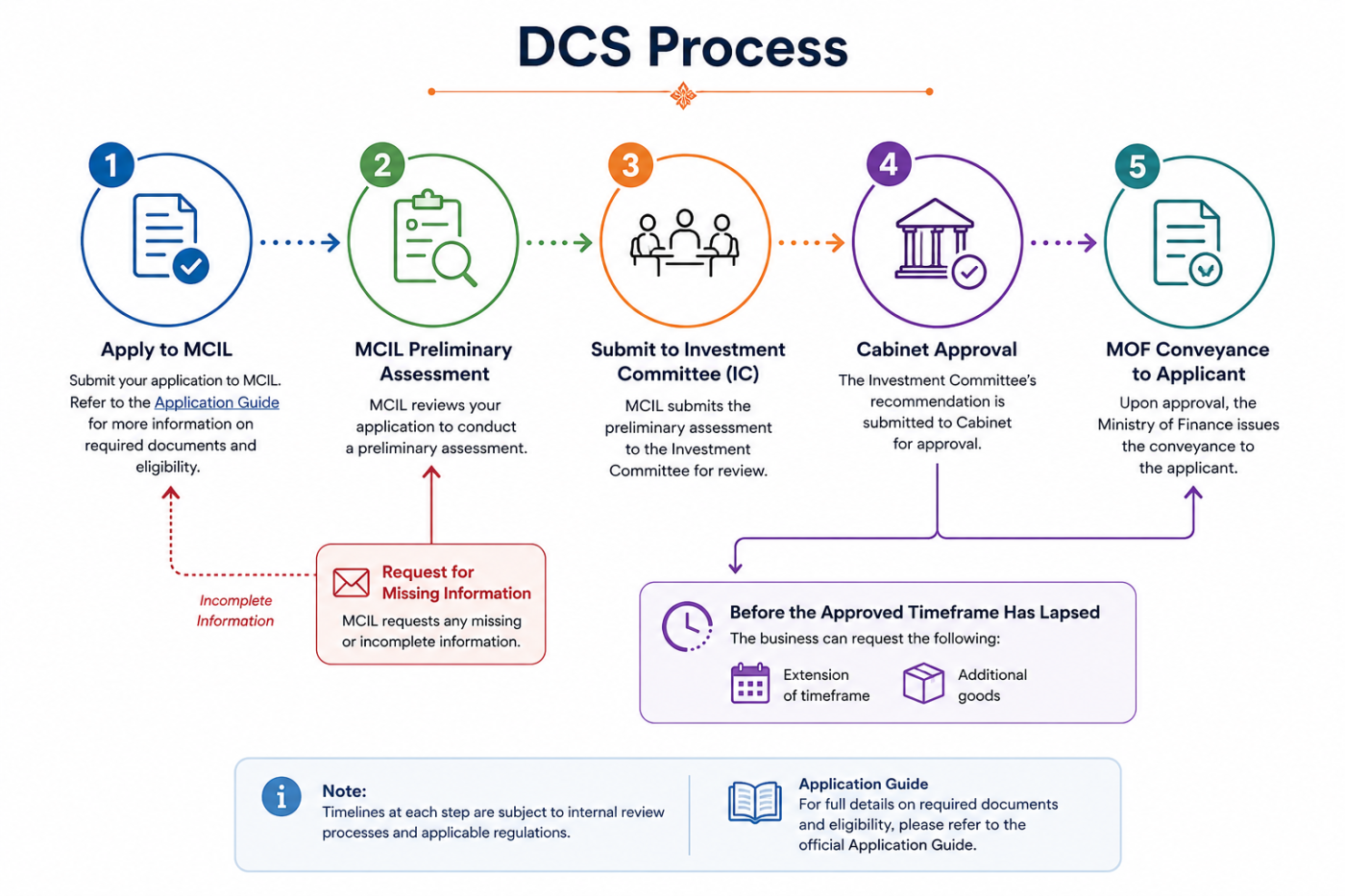
The application process has five steps:
- Apply to MCIL — submit your application to MCIL, referring to the Application Guide for the required documents and eligibility.
- MCIL preliminary assessment — MCIL reviews your application; you may be asked to supply any missing or incomplete information.
- Submit to the Investment Committee — MCIL submits the preliminary assessment to the Investment Committee for review.
- Cabinet approval — the Investment Committee's recommendation is submitted to Cabinet for approval.
- Conveyance to applicant — on approval, the Ministry of Finance conveys the outcome to the applicant.
Before the approved timeframe lapses, a business may request an extension of the timeframe or the addition of further goods. Each step is subject to internal review processes and applicable regulations.
Forms & downloads
- Duty Concession Scheme — Brochure (PDF)
- Duty Concession Scheme — Application Form & Guidelines (PDF)
Code 121
The Code 121 Scheme is mandated by the Customs Tariff Amendment Act 2008, and supports the development of selected domestic industries by exempting customs duty (from 8% to 0%) on imported raw materials.
Eligible categories include Commercial Poultry Farmers, Commercial Manufacturers of Agricultural Products, Commercial Handicraft Manufacturers, and Commercial Elei Garment Manufacturers.
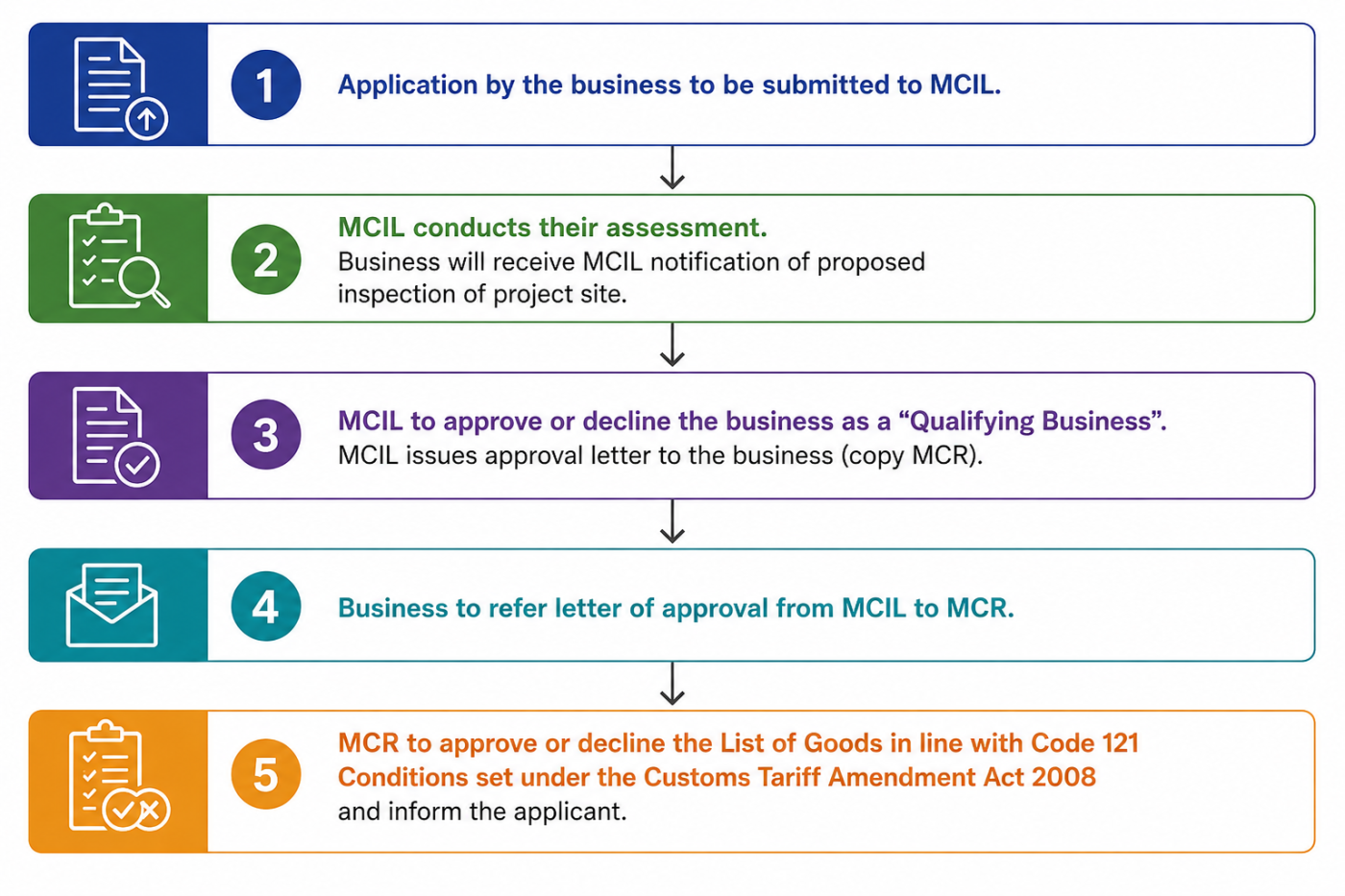
The application process has five steps:
- Apply to MCIL — the business submits an application to MCIL.
- MCIL assessment — MCIL conducts its assessment; the business is notified of a proposed inspection of the project site.
- Qualifying Business decision — MCIL approves or declines the business as a "Qualifying Business" and issues an approval letter (copy to the Ministry of Customs and Revenue).
- Refer to MCR — the business refers the MCIL approval letter to the Ministry of Customs and Revenue (MCR).
- Approval of goods — MCR approves or declines the list of goods in line with the Code 121 conditions set under the Customs Tariff Amendment Act 2008, and informs the applicant.
For more information, please refer to the application form and guidelines below.
Forms & downloads
Aviation Transport Development Scheme
The Aviation Transport Development Scheme encourages the development of Samoa's aviation transport sector by exempting customs duty on approved aircraft and parts imported by small aircraft carriers.
The scheme operates under the Customs Amendment Act 2007 (Section 163A) and the Customs (Aviation Transport Development) Regulation 2012.
To be eligible, an applicant's project must:
- Benefit the economy of Samoa and serve the public interest.
- Be new to Samoa, and either establish a new travel route or re-establish a route no longer serviced.
- Be operated by an applicant who does not run aviation transport services in any other country.
Contact MCIL for the Aviation Transport Development Guidelines and Application Form.
Forms & downloads
- Aviation Transport Development Scheme — Brochure (PDF)
- Duty Concession Scheme — Aviation Transport Development Guidelines (PDF)
MSME Development Policy and Strategy
The MSME Development Policy and Strategy recognises the importance of micro, small, and medium enterprises (MSMEs) to Samoa's economy.
Vision. Samoa will have a sustainable and globally competitive MSME sector that contributes to growth in GDP, employment, and exports.
The Policy supports MSME growth through partnerships with the private sector, capacity-building programmes, and improved access to finance and markets.
Forms & downloads
- Micro, Small and Medium Enterprises (MSME) Development Policy and Strategy (PDF)
- MSME Policy — Brochure (PDF)
National Industry Development Policy and Strategy (NIDPS) FY2024/25 – FY2033/34
The National Industry Development Policy and Strategy (NIDPS) sets Samoa's ten-year framework for diversified industrial growth, addressing post-COVID recovery and long-term productivity improvements.
Vision. Accelerated transformation of priority industries where Samoa has a potential competitive advantage that contributes to sustainable and inclusive economic growth.
NIDPS's ten-year horizon is the first phase of a multi-decade process to transform Samoa's economy towards more productive and profitable industries. The strategy is operationalised through the Trade, Commerce and Manufacturing (TCM) Sector Plan 2024/25 – 2028/29 — see below.
Forms & downloads
Guide to Private Sector Development Programs in Samoa
The main purpose of this Guide is to provide clear and reader-friendly information on all the private sector development programs operating in Samoa. It allows stakeholders to understand the objectives, criteria, operations and relevance of each program, improving the prospects for effective collaboration and flow-on benefits to the private sector. The Guide is reviewed and updated annually.
Forms & downloads
Trade, Commerce & Manufacturing Sector Plan
MCIL leads the Trade, Commerce and Manufacturing Sector — one of Samoa's 14 development sectors and the lead implementer of Key Priority Area 9 (Business Innovation and Growth) under the Pathway for the Development of Samoa 2021/22–2025/26. The Sector Plan 2024/25 – 2028/29, the third strategic plan for the sector, sets out shared goals with industry partners to grow productive capacity, deepen market linkages, and build resilient supply chains using a sector-wide approach to planning.
Vision
Sustainable production, trade, commerce and manufacturing for growth and a resilient and vibrant economy.
The plan's long-term goal is to cultivate the full potential of trade, commerce and manufacturing for the benefit of all.
Six strategic outcomes
- Improve productivity, manufacturing and trade activities.
- Enhance exports and market access.
- Increase sustainable business development and employment generation.
- Advance the efficacy of the sector infrastructure.
- Foster resilience and recovery in response to shocks and stressors.
- Strengthen an enabling environment for sector development.
MCIL's near-term operational focus within these outcomes includes formalising informal manufacturers, boosting export readiness, strengthening standards and certification, integrating women and youth enterprise, and improving trade data.
Governance & coordination
Implementation is overseen by the TCM Sector Steering Committee (TCMSSC), co-chaired by MCIL and the Ministry of Foreign Affairs and Trade, reporting through the Cabinet Development Committee. MCIL's Policy, Planning and Project Management Division (PPPMD) serves as Secretariat and coordinates sector activities day-to-day. Six Sector Working Groups — one per strategic outcome — bring technical expertise from government, the private sector, and civil society into implementation.
Sector members include:
- Ministry of Foreign Affairs and Trade
- Ministry of Finance
- Ministry of Customs and Revenue
- Ministry of Agriculture and Fisheries
- Ministry of Natural Resources and Environment
- Ministry of Works, Transport and Infrastructure
- Ministry of Education, Sports and Culture
- Ministry of Women, Community and Social Development
- Ministry of Health
- Ministry of Communication and Information Technology
- Public Service Commission
- Office of the Attorney General
- Samoa Bureau of Statistics
- Central Bank of Samoa
- Scientific Research Organisation of Samoa
- Samoa Tourism Authority
- National University of Samoa
- Samoa Business Hub
- Samoa Export Authority
- Samoa Chamber of Commerce and Industry
- Samoa Association of Manufacturers and Exporters
- Women In Business Development Incorporated
- Samoa Umbrella for Non-Governmental Organisations
Sector coordination forum: MCIL's PPPMD coordinates the TCM Sector Steering Committee (TCMSSC) and its six Sector Working Groups, bringing together government, private sector, and civil society members to track plan progress and resolve bottlenecks.